Seed Oils: What the Research Says
What seed oils are, how they're made, what the research on omega-6 fats and inflammation shows, and how to choose cooking fats without the fear.

Few kitchen ingredients start as many arguments as seed oils. Some people call them toxic. The American Heart Association counts polyunsaturated oils as part of a heart-healthy pattern (Sacks et al., 2017). This guide covers what seed oils are, what the research says, and where the questions are still open, so you can choose fats for your own kitchen.
What Are Seed Oils?
Seed oils are oils pressed or extracted from plant seeds. Common examples are canola (rapeseed), soybean, sunflower, safflower, corn, grapeseed and cottonseed oil. They’re often sold as “vegetable oil.” Most are high in linoleic acid, an omega-6 fat. Canola also has a fair amount of omega-3.
How They’re Made
Most supermarket seed oils are refined. Manufacturers usually extract the oil with a solvent (often hexane), then degum, bleach and deodorize it so it has a neutral taste and a long shelf life. Cold-pressed versions skip the solvent and keep more flavor, but they cost more and some aren’t suited to high heat.
Refining sounds alarming, but how a food is processed doesn’t tell you whether it’s healthy on its own. The useful question is what happens in people who eat it, and that’s what the next section covers.
Omega-6 and Inflammation: What the Studies Show
The main worry about seed oils is that linoleic acid turns into inflammatory compounds in the body. In theory it can be a building block for them. But when researchers reviewed randomized controlled trials in healthy adults, they found almost no evidence that eating more linoleic acid raised inflammation markers in the blood (Johnson and Fritsche, 2012).
Long-term studies point the same way. A meta-analysis of prospective cohort studies found that people who ate more linoleic acid had a lower rate of coronary heart disease, not a higher one (Farvid et al., 2014). Observational studies like these show associations, not cause and effect. The American Heart Association’s 2017 advisory concluded that replacing saturated fat with unsaturated fats, especially polyunsaturated ones, lowers heart disease rates when it’s part of an overall healthy eating pattern such as the Mediterranean diet (Sacks et al., 2017).
Where the Research Is Still Open
The evidence isn’t all one-sided. A large Cochrane review of trials found that eating more omega-6 fat made little or no difference to most heart outcomes, though it may slightly lower heart-attack risk and total cholesterol (Hooper et al., 2018). Its authors say the benefits “remain to be proven.” You may also read about the “ideal” ratio of omega-6 to omega-3 fats. That idea is popular, but the studies cited here don’t settle it.
The reviews cited above suggest seed oils aren’t toxic in normal amounts. If you want to eat less of them, fried food and packaged snacks are an obvious place to start, and cutting back on those is a reasonable habit whatever oil they use.
Choosing Cooking Fats
You don’t need to ban any oil. A practical approach:
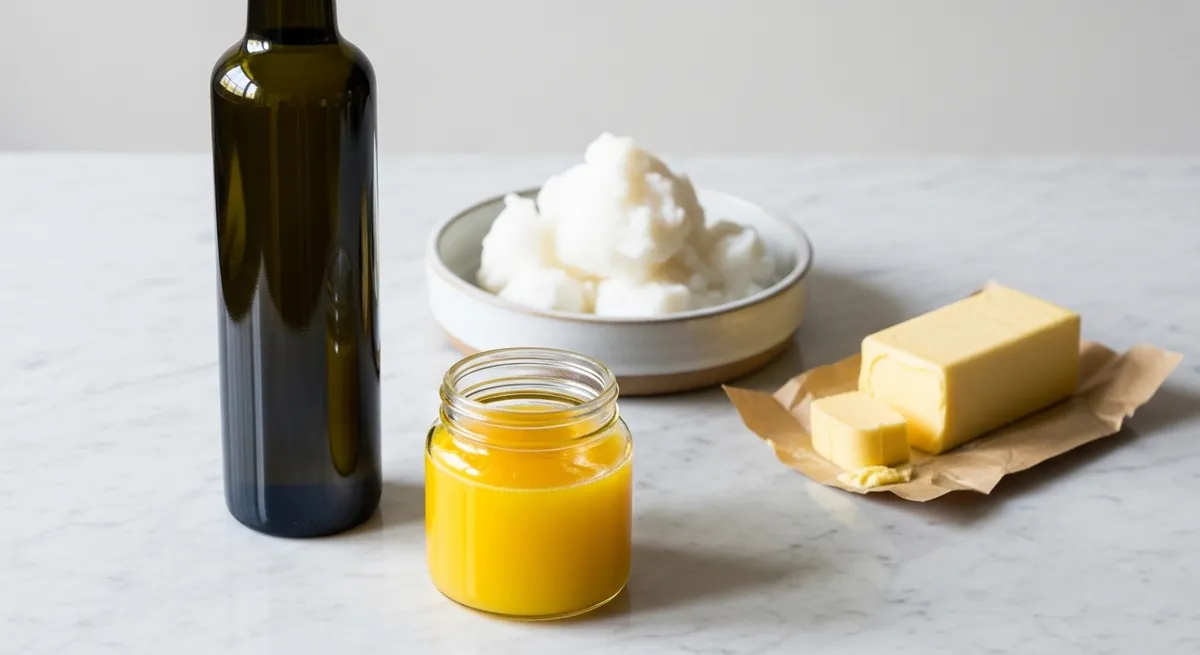
- Extra-virgin olive oil for dressings, drizzling and everyday cooking. It’s a staple of the Mediterranean diet. Look for a harvest date and a dark bottle.
- Canola or other neutral oils for baking and high-heat cooking when you want a mild taste.
- Avocado oil for high heat.
- Butter, ghee or coconut oil for flavor, in smaller amounts. They’re high in saturated fat.
- Fry less often.
- Cook at home more, and add omega-3 sources such as oily fish, walnuts or flaxseed.
If you have high cholesterol, heart disease, diabetes or another condition affected by diet, talk to your doctor or a registered dietitian before making big changes to the fats you eat.
Frequently Asked Questions
Are seed oils bad for you?
Current research doesn’t show that seed oils are harmful in normal amounts. Trials in healthy adults haven’t found that linoleic acid raises inflammation markers (Johnson and Fritsche, 2012). Some questions are still open, so a varied diet with a mix of fats is a sensible middle ground.
What can I cook with instead?
Extra-virgin olive oil works for most everyday cooking. Avocado oil and refined olive oil suit high heat. Butter and ghee add flavor but are high in saturated fat, so use them in smaller amounts.
Is olive oil a seed oil?
No. Olive oil is pressed from the olive fruit. It’s mostly monounsaturated fat (oleic acid).
Is cold-pressed better than refined?
Cold-pressed oils keep more flavor and some antioxidants. Refined oils have a higher smoke point and a neutral taste. Both have a place, and there’s no strong evidence that one is healthier than the other for everyday cooking.
How do I eat less seed oil when eating out?
Many restaurants use seed oils for frying. Choosing grilled, roasted or steamed dishes more often than fried ones cuts down on it. Don’t stress about occasional meals out.
Sources
- Johnson GH, Fritsche K. Effect of dietary linoleic acid on markers of inflammation in healthy persons: a systematic review of randomized controlled trials. J Acad Nutr Diet. 2012. https://pubmed.ncbi.nlm.nih.gov/22889633/ (“virtually no evidence… that addition of LA to the diet increases the concentration of inflammatory markers”)
- Farvid MS, et al. Dietary linoleic acid and risk of coronary heart disease: a systematic review and meta-analysis of prospective cohort studies. Circulation. 2014. https://pubmed.ncbi.nlm.nih.gov/25161045/ (“dietary LA intake is inversely associated with CHD risk”)
- Sacks FM, et al. Dietary Fats and Cardiovascular Disease: A Presidential Advisory From the American Heart Association. Circulation. 2017. https://pubmed.ncbi.nlm.nih.gov/28620111/ (“replacing it with unsaturated fats, especially polyunsaturated fats, will lower the incidence of CVD”; the shift “should occur simultaneously in an overall healthful dietary pattern such as DASH… or the Mediterranean diet”)
- Hooper L, et al. Omega-6 fats for the primary and secondary prevention of cardiovascular disease. Cochrane Database Syst Rev. 2018. https://pubmed.ncbi.nlm.nih.gov/30488422/ (“benefits of omega-6 fats remain to be proven”; “may reduce myocardial infarction (MI) risk”; “reduce serum total cholesterol”)