Why Korean Sunscreen Is Different
What makes Korean sunscreens better than most Western options. the formulation differences, the texture revolution, and why it changed how we think about sun protection.
This post contains affiliate links; we may earn a commission at no cost to you.
Top pick: Product photo of beauty joseon relief sun aqua — shop at Mirai

Product photo: Beauty of Joseon Relief Sun Aqua-fresh Rice+B5 (SPF50+ PA++++) 50ml. Source image.
This post contains affiliate links; we may earn a commission at no cost to you.
Code ROOTEDGLOW10 takes 10% off at Mirai Skin (one code per order).
Mirai Skin ships from South Korea: $11 flat to the EU, other rates at checkout; usually 7–14 business days after a 3–5 day dispatch. Import duties, if any, are paid by the buyer.
There’s a simple test we give anyone who claims they wear sunscreen daily: show us your sunscreen.
If it’s a thick, white, greasy cream that smells like a swimming pool and leaves a visible cast on the skin, we understand why “daily” really means “sometimes at the beach.”
Many people know they should wear sunscreen every day but skip it because the formula feels unpleasant. That makes daily use hard.
Korean sunscreens are often designed to feel light and wear well under makeup, which can make daily use easier.
The Fundamental Problem with Western Sunscreen
Most sunscreens available in American and European drugstores are formulated with one goal: UV protection. Everything else (texture, finish, scent, wearability under makeup) is an afterthought.
The result:
- Heavy, greasy texture that sits on top of the skin
- White cast from zinc oxide and titanium dioxide particles that are too large
- Unpleasant smell (the classic “sunscreen smell” that signals summer but also signals “I have product on my face”)
- Pilling under makeup or moisturizer
- Pore-clogging formulas that cause breakouts in acne-prone skin
These issues aren’t minor cosmetic complaints. They’re the primary reason most people don’t wear sunscreen daily. And daily wear is what matters. Occasional beach application doesn’t protect against the cumulative UV damage that happens during a regular Tuesday.
What Makes Korean Sunscreen Different
Korean sunscreen development operates under a different assumption: sunscreen must be something people want to wear every single day. This means it has to feel like skincare, not like a protective coating.
The Texture Revolution
Pick up a popular Korean sunscreen (Beauty of Joseon Relief Sun Aqua-Fresh, Isntree Hyaluronic Acid Watery Sun Gel, or Missha All Around Safe Block) and you’ll notice something immediately: it doesn’t feel like sunscreen.
It feels like a lightweight moisturizer. Or a primer. Or a tone-up cream. Layer it over your favorite Korean serums and the combination is unbeatable. It absorbs in seconds, leaves a dewy or matte finish (your choice), and disappears into the skin without a trace.
This isn’t marketing magic. It’s formulation science. Korean cosmetics labs invest heavily in texture engineering, using refined UV filter particles, lightweight emulsion systems, and hydrating bases that deliver sun protection in an elegant vehicle.
UV Filter Innovation
This is the technical advantage. Korean (and other Asian) sunscreens have access to newer UV filters that aren’t yet approved by the FDA for use in the US. Key filters include:
Tinosorb S and Tinosorb M (Bemotrizinol and Bisoctrizole). Broad-spectrum filters that cover both UVA and UVB. Extremely photostable (they don’t break down in sunlight, unlike many older filters). Gentle on skin.
Uvinul A Plus (Diethylamino Hydroxybenzoyl Hexyl Benzoate). A powerful UVA filter that’s especially effective at blocking the deep-penetrating UVA1 rays responsible for collagen breakdown and aging.
Uvinul T 150 (Ethylhexyl Triazone). A UVB filter with exceptionally high absorption efficiency, meaning less of it is needed for the same protection level. Less filter = lighter texture.
American sunscreens rely heavily on older filters: avobenzone (which degrades in sunlight), octinoxate (which has endocrine disruption concerns), or mineral filters (zinc oxide and titanium dioxide, which tend to be thick and white).
The FDA hasn’t approved a new sunscreen filter since 1999. The Korean (and European) regulatory systems have approved multiple new-generation filters since then. This regulatory gap is the single biggest reason Korean sunscreens feel different.
The PA++++ System
SPF (Sun Protection Factor) measures protection against UVB rays, the rays that cause sunburn. But UVA rays (which penetrate deeper, cause aging, and contribute to skin cancer) are equally important.
Korean sunscreens use the PA rating system to indicate UVA protection:
- PA+ = some UVA protection
- PA++ = moderate
- PA+++ = high
- PA++++ = extremely high
Most popular Korean sunscreens are PA++++. This gives consumers clear, standardized information about UVA protection that Western “broad spectrum” labeling doesn’t provide (the FDA’s “broad spectrum” threshold is relatively low).
When we say Korean sunscreens protect better, we’re specifically referring to this UVA advantage. Deep UVA1 rays are the primary drivers of photoaging (wrinkles, sagging, hyperpigmentation), and Korean sunscreens block them more effectively.
Types of Korean Sunscreen
Chemical (Organic) Sunscreens
These use chemical UV filters that absorb UV radiation and convert it to heat. Modern Korean chemical sunscreens use the newer filters mentioned above, which are more stable and less irritating than older options.
Pros. Lightweight, no white cast, elegant texture, often hydrating.
Cons. Some people with very sensitive skin react to chemical filters. Can sting eyes if it migrates.
Good for. Most skin types, daily wear, under makeup.
Physical (Mineral) Sunscreens
Use zinc oxide, titanium dioxide, or both to physically reflect UV radiation.
Korean mineral sunscreens have largely solved the white cast problem through micronized (very finely milled) particles. They’re still slightly less elegant than chemical options, but dramatically better than Western mineral sunscreens.
Pros. Gentle on sensitive skin, reef-safe, no chemical absorption into the skin.
Cons. Can be slightly heavier. May still show a faint cast on deeper skin tones (though Korean brands are improving rapidly).
Good for. Sensitive skin, reactive skin, post-procedure skin.
Hybrid Sunscreens
A combination of chemical and mineral filters. These often deliver the best of both worlds: the light texture of chemical filters with the gentleness and broad-spectrum coverage of mineral filters.
Good for. Most people. This is the category where many of the best Korean sunscreens fall.
Our Favorites
These shortlist picks map to exact Mirai listings we can check today (stock noted 25 October 2026). Myths and PA++++ education above still matter more than any single bottle.
Affiliate disclosure: We may earn a commission through Mirai Skin links. Plain product URLs below — Rooted tracking.js stamps UTMs on click.
For Everyday Wear — Beauty of Joseon Relief Sun Aqua-Fresh
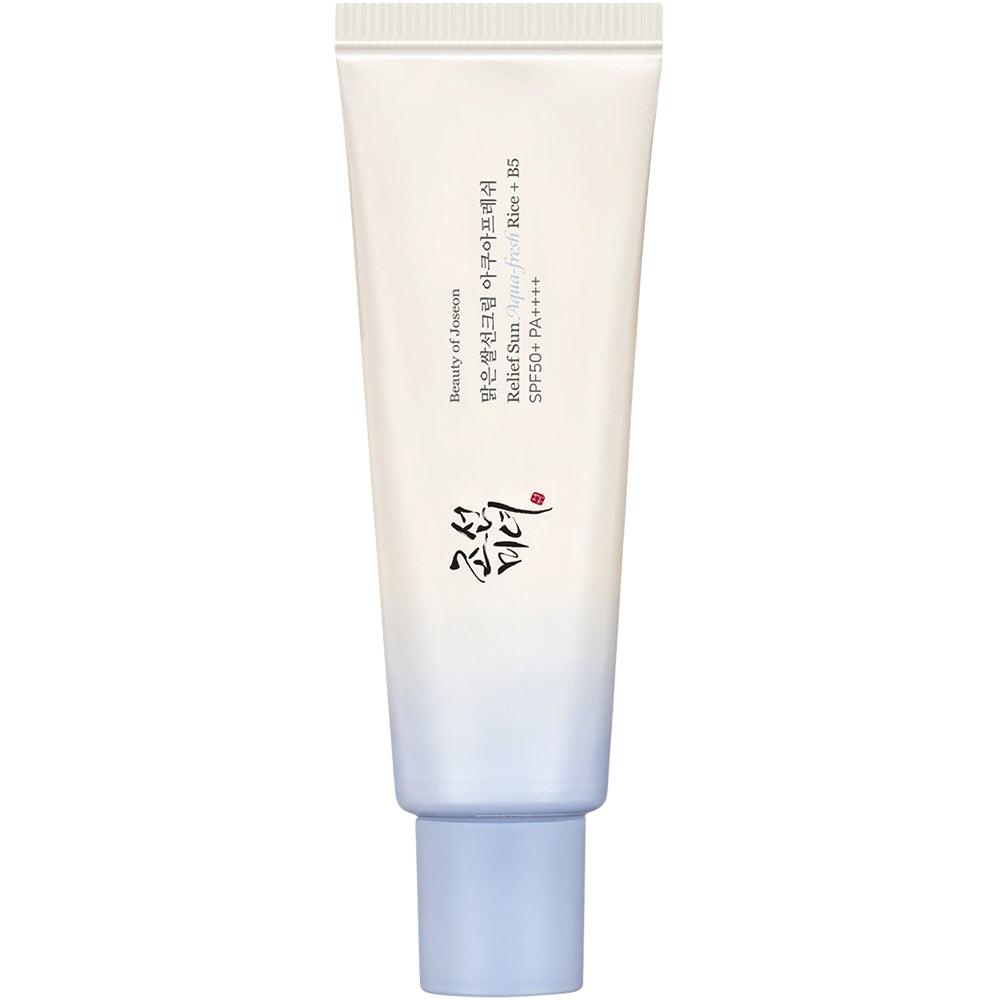
Beauty of Joseon Relief Sun Aqua-Fresh: Rice + B5 (SPF50+ PA++++). This is the Aqua-Fresh formula (not the Original Rice + Probiotics Relief Sun). Lightweight, slightly dewy, works under makeup, and the Mirai photo matches this exact SKU. No white cast on medium and deeper skin tones for most wearers we hear from — still patch-test if you are reactive.
Texture. Like a thin, hydrating moisturizer. Absorbs in seconds.
Check BoJ Relief Sun Aqua-Fresh at Mirai →
Optional compare (same brand, different finish): Original Relief Sun Rice + Probiotics if you specifically want that classic formula.
For a deeper dive into why Beauty of Joseon SPF keeps winning K-beauty roundups, Mirai Skin breaks it down in 7 reasons why Beauty of Joseon sunscreen is best.
For Oily / Combo Skin — start on Glow, then pick a Mirai SKU
For oily and acne-prone readers who want a no-white-cast compare (Aqua-Fresh vs Original plus buying checks), use Glow’s full guide: Best Korean Sunscreens for Oily Skin (No White Cast). Soft sister-site link only.

Isntree Hyaluronic Acid Daily Sun Gel (secondary pick). Gel texture that dries down non-greasy; hyaluronic acid for light hydration. Confirm the exact Mirai listing (size / SPF label on the PDP) before you treat it as a drop-in Aqua-Fresh substitute — BoJ Aqua-Fresh remains the everyday Mirai CTA above.
Texture. Watery gel that sets to a matte-leaning finish.
For Sensitive Skin
Round Lab Birch Juice Moisturizing Sun Cream (SPF50+ PA++++). Gentle formulation with birch juice for soothing. Minimal ingredients, no fragrance. One of the best options for reactive or easily irritated skin.
Texture. Light cream, comfortable all day.
For a Matte Finish
Missha All Around Safe Block Aqua Sun Gel (SPF50+ PA++++). Dries completely matte. Excellent for humid climates or oily skin types that can’t tolerate any dewiness. Works as a makeup primer.
Texture. Gel that dries to a powdery, matte finish.
For Light / Centella Wear — SKIN1004 Air-Fit Plus
SKIN1004 Madagascar Centella Air-Fit Suncream Plus (SPF50+ PA++++), 50 ml. Light centella-leaning daily SPF — this is the Air-Fit Plus SKU Mirai carries (not the Hyalu-Cica Water-Fit serum line). Confirm ingredients and stock on the current listing.
Check SKIN1004 Air-Fit Plus SPF at Mirai →
Texture. Lightweight cream; everyday finish without a heavy cast for most skin tones.
How to Apply Korean Sunscreen
Proper application matters more than the product you choose:
Amount. Two finger-lengths (squeeze a line of product along your index and middle finger from tip to base). This is approximately 1/4 teaspoon, the amount used in SPF testing. Most people apply far too little, which dramatically reduces actual protection.
Method. Dot the product across your forehead, cheeks, nose, and chin. Then spread and pat gently. Don’t rub vigorously (it can break down the UV filter matrix).
Timing. Apply as the last step of your skincare routine, before makeup. For the full sequence, see our complete AM wellness routine. Modern Korean sunscreens provide protection immediately upon application (the old “wait 15 minutes” advice was based on older formulations).
Reapplication. Every 2 hours of sun exposure. For indoor days with minimal sun exposure (office work, for example), a single morning application is generally sufficient, though reapplication at midday is ideal if you’re near windows.
Common Myths
“I don’t need sunscreen on cloudy days.” Up to 80% of UV radiation penetrates clouds. You need sunscreen.
“I have dark skin, so I don’t need sunscreen.” Darker skin tones have more melanin, which provides some natural protection, but they’re still susceptible to UV damage, hyperpigmentation, and skin cancer. Everyone benefits from daily sunscreen.
“SPF 30 is enough.” SPF 30 blocks about 97% of UVB rays. SPF 50 blocks about 98%. The difference is small in theory, but given that most people under-apply (getting maybe SPF 15 from an SPF 30 product), starting with SPF 50 provides a larger margin of error.
“Sunscreen causes breakouts.” Some sunscreens cause breakouts. Modern Korean formulations are designed for daily wear on acne-prone skin. If you’ve been breaking out from sunscreen, you haven’t tried the right one yet.
The Daily Wear Difference
Wearing sunscreen occasionally (beach days, hiking) prevents sunburn. Wearing sunscreen daily prevents aging.
UV damage is cumulative. The 15 minutes of sun you get walking to your car, sitting by a window, running errands. It adds up over months, years, and decades. Photoaging (wrinkles, dark spots, loss of elasticity) is primarily caused by this everyday, incidental exposure, not by the occasional beach trip.
Korean consumers understand this intuitively, which is why sunscreen is the number-one skincare category in South Korea. It’s not vanity. It’s the single most evidence-based anti-aging product available. Pair it with a proper K-beauty night routine and you have a complete protection-and-repair system.
Find a Korean sunscreen you enjoy wearing. Apply it every morning. Your future skin will be grateful. If you’re a runner or outdoor exerciser, see our guide to Korean skincare for runners for tips on sweat-resistant application.
For specific product testing across multiple skin tones, see 10 Sunscreens With No White Cast on Glow Coded.
For how PA ratings and filter approvals differ by region, see Glow Coded’s Korean SPF vs Western SPF comparison.
Frequently Asked Questions
Are Korean sunscreens FDA approved?
Korean sunscreens are regulated by MFDS (Korea’s Ministry of Food and Drug Safety), not the US FDA. They meet international ISO testing standards for SPF and PA ratings. While they’re not FDA-approved, they often use newer, more effective UV filters that the FDA simply hasn’t reviewed yet due to regulatory backlog.
Do Korean sunscreens work for dark skin tones?
Yes, and this is one of their biggest advantages. Many Korean sunscreens use chemical UV filters that are completely invisible on all skin tones, unlike mineral sunscreens that can leave a white or ashy cast on darker skin. Look for products labeled “no white cast” and check for chemical-only filter lists.
Can you use Korean sunscreen on children?
For children, mineral sunscreens (zinc oxide, titanium dioxide) are generally recommended because they sit on top of the skin rather than being absorbed. Some Korean brands make children’s sunscreens, but always check the ingredients. Chemical UV filters are safe for adults but some pediatricians prefer mineral-only formulas for young children.
How do PA ratings compare to broad spectrum labels?
PA ratings specifically measure UVA protection on a scale from PA+ to PA++++. PA++++ is the highest rating and means the product blocks over 95 percent of UVA rays. The US “broad spectrum” label only means the product provides some UVA protection but doesn’t tell you how much. PA ratings give you more precise information about UVA defense.
Related Reading
- Korean Chemical vs Mineral Sunscreens: 2026 Comparison — a detailed breakdown of filter types, textures, and which works best for your skin
- Vitamin C Serum Morning Routine: Korean Layering 2026 — how to layer Vitamin C before sunscreen the Korean way for maximum protection and glow
- K-Beauty Night Routine for Glowing Skin — the full Korean routine framework that sunscreen anchors each morning