Hip Flexor Stretches and Exercises: Fix Tight Hips for Good
10 best hip flexor stretches and strengthening exercises for runners and desk workers. Includes a 5-minute and 15-minute daily routine with clear instructions.

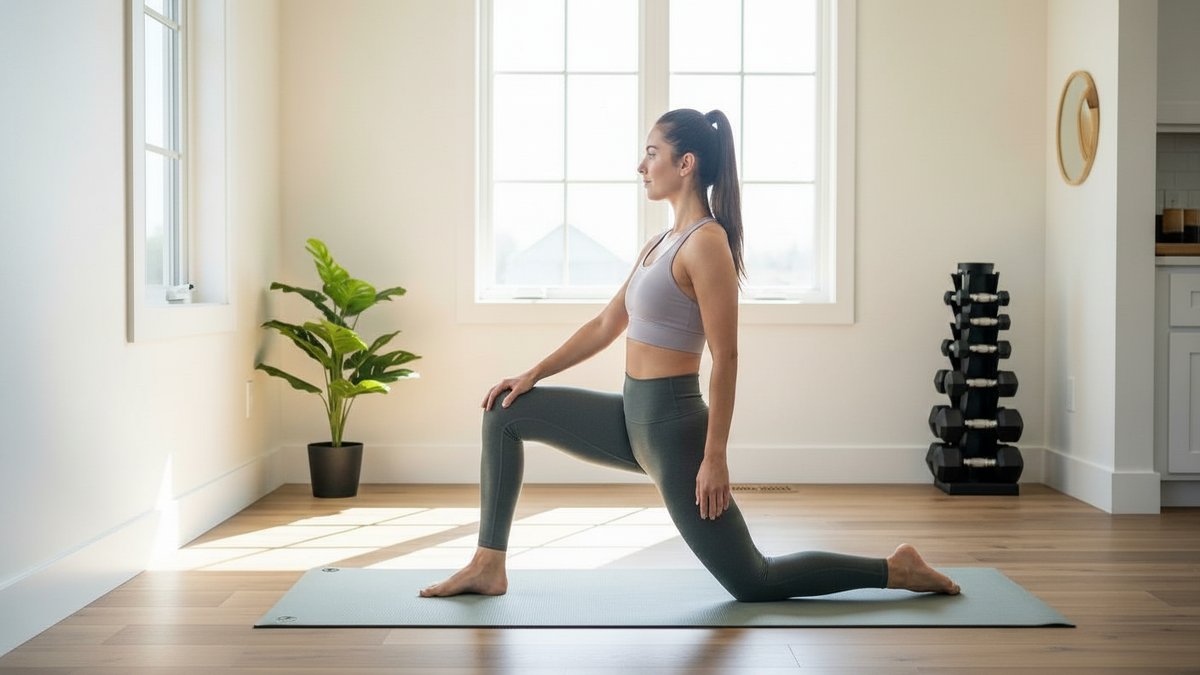
Tight hip flexors are the silent saboteur behind lower back pain, poor posture, reduced running stride, and even knee problems. If you sit for 6+ hours a day or run regularly, your hip flexors are almost certainly short, stiff, and overworked.
The fix isn’t just stretching — it’s a combination of lengthening tight muscles and strengthening weak ones. Here’s the complete guide.
Why Your Hip Flexors Are Tight
Your hip flexors (primarily the iliopsoas — the iliacus and psoas major — plus the rectus femoris) connect your spine and pelvis to your thigh bone. They flex the hip, meaning they fire every time you lift your leg, climb stairs, run, or simply sit.
Sitting is the main culprit. When you sit, hip flexors are in a shortened position for hours. Over time, the muscles adapt: they become physically shorter and stiffer, pulling your pelvis into an anterior tilt. This creates a cascade:
- Anterior pelvic tilt compresses the lower back
- Glutes become inhibited (reciprocal inhibition — tight hip flexors shut down their opposing muscles)
- Running stride shortens because the hip can’t fully extend
- Knee tracking changes because the rectus femoris crosses both the hip and knee joints
Running compounds the problem. Each stride requires hip flexion. High-mileage runners fire their hip flexors thousands of times per run, building strength in flexion but rarely training full extension.
The Stretches (Lengthening)
Hold each stretch for 30–60 seconds per side. Breathe deeply and lean into the stretch gradually — never force.
1. Half-Kneeling Hip Flexor Stretch
The foundational hip flexor stretch. Kneel on your right knee with your left foot flat on the floor in front (90-degree angle at both knees). Tuck your pelvis under (posterior pelvic tilt), squeeze your right glute, and shift your weight forward. You should feel a deep stretch in the front of your right hip. Raise your right arm overhead to intensify.
2. Couch Stretch
The most intense hip flexor stretch you can do. Face away from a wall or couch. Place your right knee on the ground and the top of your right foot against the wall behind you (shin vertical on the wall). Step your left foot forward into a lunge. Drive your hips forward while keeping your torso upright. This simultaneously stretches the hip flexor and quadricep.
3. Pigeon Pose
From a high plank, bring your right knee forward and place it behind your right wrist, with your right shin angled across your mat. Extend your left leg straight behind you. Sink your hips toward the floor. Walk your hands forward and lower your chest for a deeper stretch. Targets the hip flexor of the back leg and the external rotators of the front leg.
4. 90/90 Stretch
Sit on the floor with your front leg bent at 90 degrees in front of you (knee pointing forward) and your back leg bent at 90 degrees behind you (knee pointing to the side). Sit tall. Lean forward over your front shin for a deep hip stretch. Rotate to lean over the back leg to target the hip flexor. This is the best stretch for overall hip mobility.
5. Standing Quad/Hip Flexor Stretch
Stand on your left leg. Grab your right ankle behind you and pull your heel toward your glute. Keep your knees together and tuck your pelvis under. This targets the rectus femoris (the hip flexor that crosses the knee). Simple, effective, and easy to do anywhere.
6. Supine Figure-Four Stretch
Lie on your back. Cross your right ankle over your left knee. Pull your left thigh toward your chest. This primarily targets the piriformis and deep external rotators, but it also opens the hip joint capsule and relieves tension patterns that contribute to hip flexor tightness.
7. Butterfly Stretch
Sit on the floor with the soles of your feet together, knees falling outward. Hold your feet and gently press your knees down with your elbows. Sit tall or lean forward to intensify. Targets the hip adductors and opens the front of the pelvis.
The Strengthening Exercises
Stretching alone creates temporary length. Strengthening trains your muscles to function through a full range of motion. These exercises target the glutes and core — the muscles that counterbalance tight hip flexors.
8. Glute Bridge
Lie on your back, knees bent, feet flat. Squeeze your glutes and lift your hips until your body forms a straight line from shoulders to knees. Hold 2 seconds at the top. Lower with control. 3 sets of 15. This directly counteracts the anterior pelvic tilt caused by tight hip flexors.
9. Dead Bug
Lie on your back with arms extended toward the ceiling and knees bent at 90 degrees (tabletop position). Slowly extend your right arm overhead and your left leg straight out, hovering just above the floor. Return to start. Alternate sides. 3 sets of 10 per side. Trains the deep core to stabilize the pelvis.
10. Banded Hip Flexor March
Wrap a light resistance band around your feet. Lie on your back with both legs in tabletop position. Slowly lower one foot toward the floor, keeping the other in position. The band provides resistance to both the lowering leg (eccentric hip flexor control) and the stationary leg (isometric hip flexor strength). 3 sets of 10 per side.
Daily Routines
5-Minute Quick Routine (Desk Workers)
| Exercise | Duration |
|---|---|
| Half-Kneeling Hip Flexor Stretch | 30 sec each side |
| Standing Quad/Hip Flexor Stretch | 30 sec each side |
| Glute Bridge | 15 reps |
| Butterfly Stretch | 30 sec |
Do this once at midday and once before bed. Total commitment: 10 minutes per day.
15-Minute Complete Routine (Runners)
| Exercise | Duration |
|---|---|
| Half-Kneeling Hip Flexor Stretch | 45 sec each side |
| Couch Stretch | 45 sec each side |
| Pigeon Pose | 45 sec each side |
| 90/90 Stretch | 45 sec each side |
| Glute Bridge | 3 x 15 |
| Dead Bug | 3 x 10 each side |
| Banded Hip Flexor March | 3 x 10 each side |
Do this after every run or as a standalone mobility session on rest days.
How Long Until You See Results
- Immediate: Temporary relief after each session. Reduced lower back tension.
- 2 weeks: Noticeably easier to get into stretches. Less morning stiffness.
- 4–6 weeks: Measurable improvement in hip extension range of motion. Running stride feels longer and more fluid.
- 8+ weeks: Structural changes in muscle length and pelvic position. Reduced or eliminated lower back pain from sitting.
Consistency matters more than intensity. Five minutes daily beats thirty minutes once a week.
For a broader mobility practice, see our 15-minute morning mobility routine. Runners should also check our couch to 5K plan for a structured approach that includes mobility work, and our yoga vs Pilates guide if you’re considering a formal flexibility practice.